JOREK Solver
The implicit time integration scheme implemented by JOREK leads to a large and sparse linear system of the general form
\[A\,x = b.\]The matrix $A$ is assembled in a distributed block-COO format (which can be converted to a distributed block-CSR format on demand) and is partitioned by toroidal Fourier harmonics and finite-element nodes. The solver infrastructure exploits this block structure at both the factorisation and the preconditioning level.
Two high-level solution strategies are supported:
| Direct solve | Iterative solve | |
|---|---|---|
| Input flag | gmres = .false. | gmres = .true. |
| Method | Sparse LU factorisation of $A$ | GMRES (or BiCGSTAB) with block preconditioner |
| Strengths | Robust; insensitive to conditioning | Lower memory; scales to large problems |
| Weaknesses | Memory and fill-in grow rapidly | Convergence depends on preconditioner |
| Typical use | Small-to-moderate problems | Large / production runs |
Both strategies support multiple third-party libraries as back-ends and can optionally offload the matrix–vector products to GPU hardware.
The main entry point is solve_sparse_system() in solvers/mod_sparse.f90.
Direct Solvers
When gmres = .false. in the input file, the system is passed directly to one of the supported sparse-direct libraries. The library is selected at compile time via flags (USE_MUMPS, USE_PASTIX, USE_STRUMPACK) and at runtime by the corresponding use_* input flags.
Hint: Factorization of large sparse matrices is an expensive operation and will create a lot of fill-in resulting in increased memory requirements. Thus, for most cases use of the iterative solver is recommended!
Iterative Solvers
When gmres = .true., a Krylov iterative method is used, preconditioned by the block harmonic preconditioner described in the next section.
GMRES
Left-preconditioned restarted GMRES is implemented in solvers/mod_gmres.f90. (A more modern implementation avaliable in selected branches is implemented in solvers/mod_gmres2.f90).
The algorithm applies the preconditioner $M^{-1}$ to both the initial residual and to each new Krylov vector. Orthogonalisation is performed by a Gram–Schmidt variant (classical or modified, with or without re-orthogonalisation, controlled at compile time). Givens rotations maintain the upper Hessenberg in triangular form in-place. After each restart the solution is updated as $x \leftarrow x + V y$, where $y$ minimises the preconditioned residual over the current Krylov subspace.
Convergence is declared when
\[\frac{\|r_k\|}{\|r_0\|} < \texttt{gmres_tol}\]or when the absolute residual drops below a secondary threshold.
Key input parameters:
| Parameter | Default | Description |
|---|---|---|
gmres_m | 40 | Restart dimension |
gmres_max_iter | 400 | Maximum number of outer (restarted) iterations |
gmres_tol | — | Relative residual tolerance |
BiCGSTAB
BiCGSTAB (in solvers/mod_bicgstab.f90) is an alternative that requires no restart and uses $O(n)$ memory independent of the iteration count. It applies the preconditioner twice per iteration (once for the search direction, once for the stabilizer), which is more expensive per step than GMRES but avoids restarting costs. Enable it at compile time with the USE_BICGSTAB preprocessor flag.
Hint: Use of BiSCSTAB is generally not recommended.
Preconditioner
Preconditioning is essential in solving linear systems using iterative methods. The matrices resulting from the MHD formulations in JOREK are highly ill-conditioned and iterative methods do not converge without a proper preconditioner.
We choose a preconditioner$M$ such that we solve the modified left preconditioned system
where $M$ is "cheap" to invert and $M^{-1}A$ is a reasonably good approximation of the identity. There exist many "standard" techniques that can be applied to general systems without considering the original problem. These, of course, have the benefit of being "plug-and-play" and work reasonably well for a wide range of problems. When going into very ill-conditioned problems we find most of these approaches to have little to no effect. These cases require more advanced study to create tailored preconditioners to obtain good convergence.
The block harmonic preconditioner in JOREK exploits the toroidal Fourier structure of the MHD system to construct a preconditioner $M$ whose application requires only independent sparse-direct solves on smaller sub-systems, one per mode family.
The preconditioner is set up and applied by solvers/mod_preconditioner.f90.
Concept
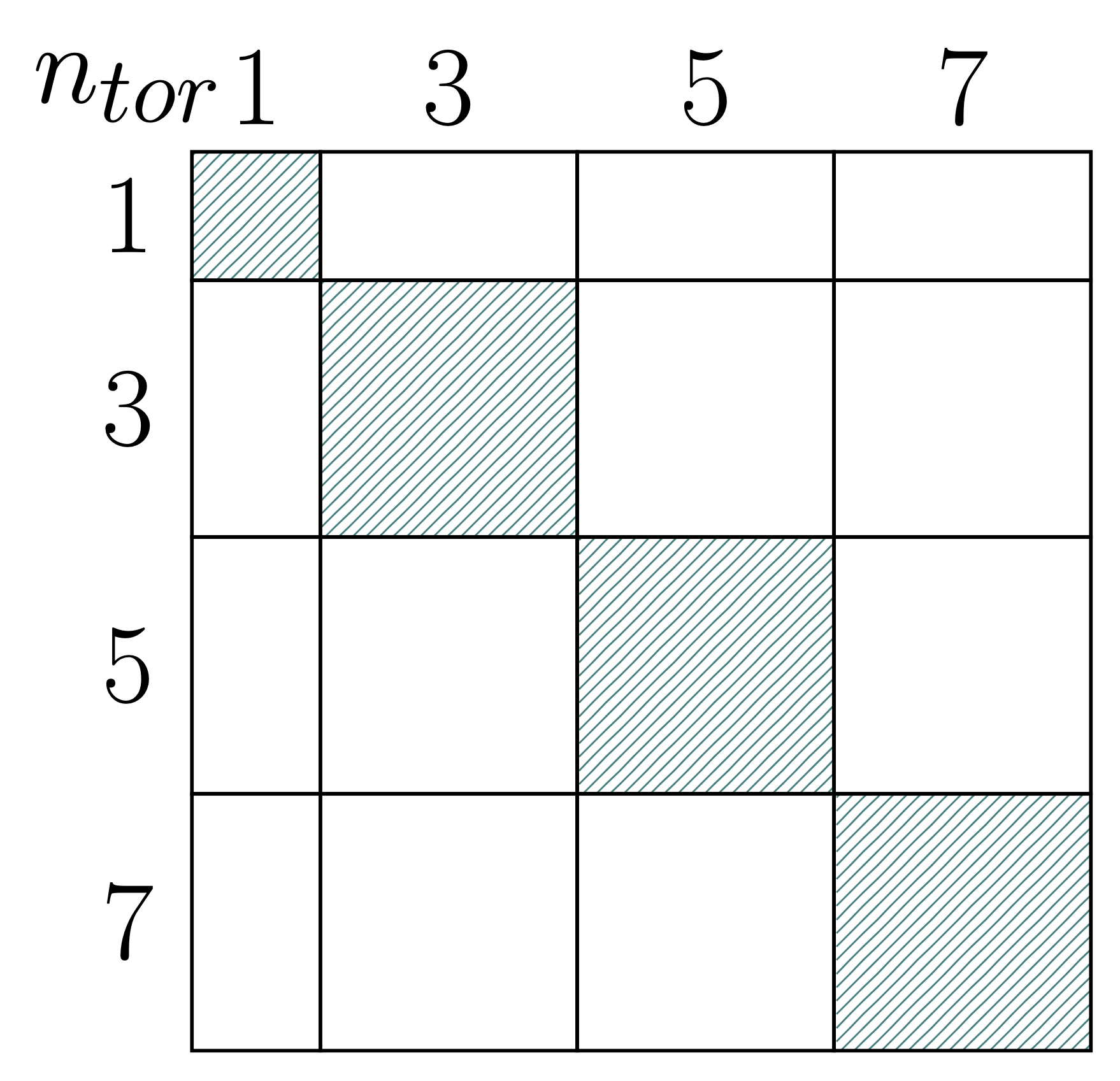
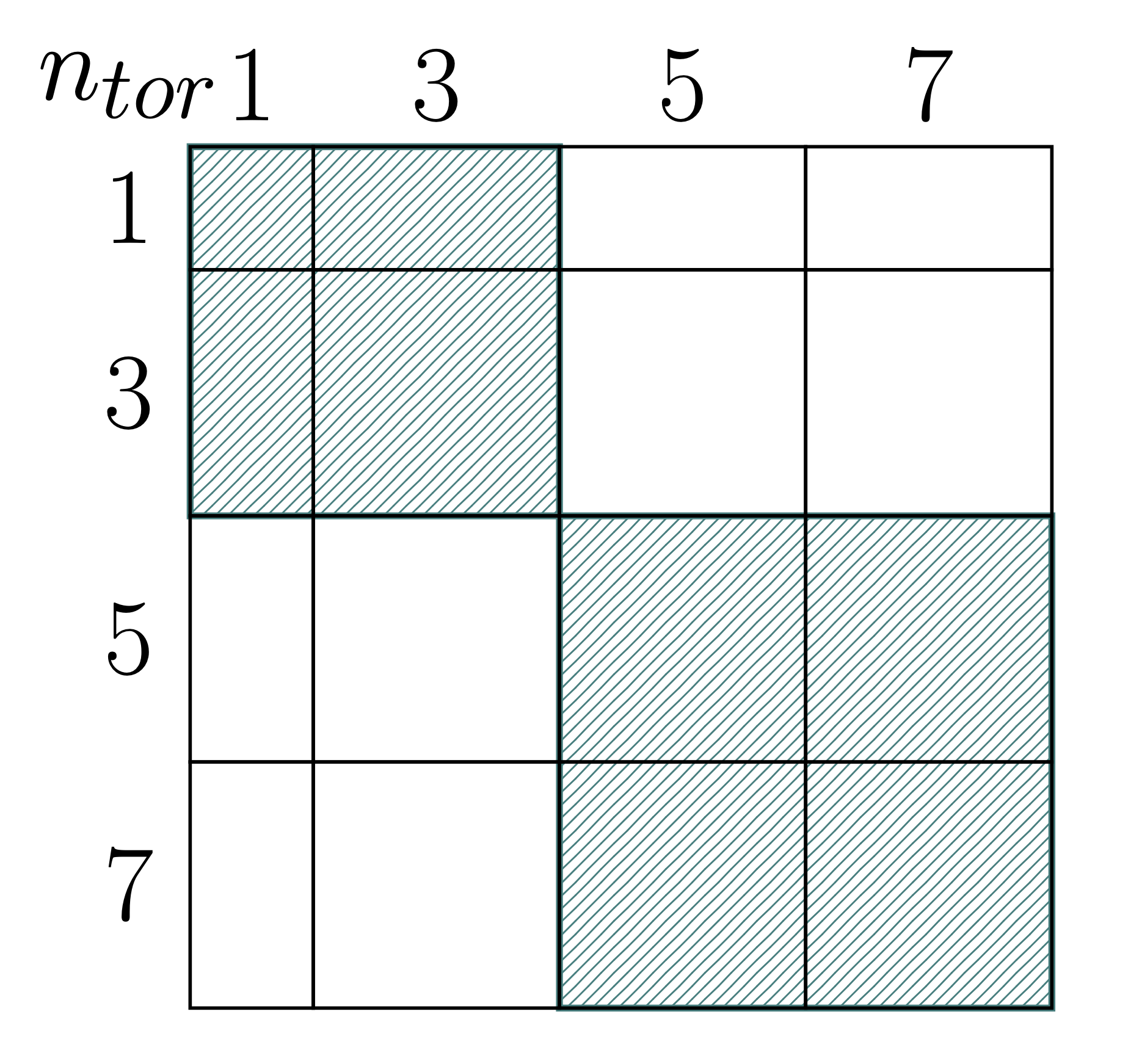
For a purely axisymmetric geometry, toroidal harmonics decouple completely: the mode-$n$ rows of the system matrix have no coupling to mode-$m \ne n$ columns. JOREK's matrix does contain inter-harmonic coupling terms (from inter-harmonic coupling terms in the system), but in many cases the dominant, physics-relevant coupling is intra-harmonic. The preconditioner $M$ is therefore built by grouping the toroidal modes into families and assembling one block-diagonal preconditioner matrix per family that retains all intra-family coupling while discarding the inter-family terms. Each mode family is then factorised independently by the selected direct-solver library.
Mode Family Distribution
Toroidal modes $0, 1, 2, 3, \ldots$ are partitioned into mode families. Two strategies are available:
- Automatic (
autodistribute_modes = .true.): mode 0 (axisymmetric) forms its own family; remaining modes are paired as $(n_1, n_2), (n_3, n_4), \ldots$ - Manual: the user specifies
n_mode_families,modes_per_family(:), andmode_families_modes(:,:)explicitly.
MPI ranks are distributed among families in the same way:
- Automatic (
autodistribute_ranks = .true.): ranks are distributed as equally as possible across families. - Manual: specified via
ranks_per_family(:).
Preconditioner Solve Workflow
Each GMRES / BiCGSTAB preconditioner application performs the following steps:
- Scatter RHS — extract the rows belonging to this mode family from the global residual vector (via pre-computed
row_indexmapping). - Solve — the family's direct solver (MUMPS / PaStiX / STRUMPACK) factorises or reuses, and solves the preconditioner matrix for the local RHS.
- Gather solution — contributions from all families are reduced by
MPI_AllReduce(sum) into the global solution vector; each family's rows are weighted byrow_factor(normally 1).
Factorisation Reuse
Refactoring the preconditioner at every time step is expensive. Thus, we can reuse the factorized preconditioner matrices over multiple timesteps, where they still provide a good approximation of the linear system. JOREK reuses the existing factorisation (the solve_only path) when:
where iter_precon and max_steps_noUpdate are input parameters. When neither condition is satisfied, the preconditioner matrix is reassembled and refactorised.
Preconditioner Matrix Assembly
Two assembly strategies are available (selected by compile-time flag DIRECT_CONSTRUCTION):
- Direct construction: each MPI rank assembles its part of the preconditioner matrix directly at the finite-element level, without the distribution step.
- Distributed construction: the full system matrix is communicated via
MPI_ALLTOALLVto the rank groups that own each mode family, which then extract their rows locally.
PETSc Integration
Note: PETSc-based solver paths are under active development. This section will be expanded once the implementation stabilises.
When compiled with USE_PETSC, an alternative solver path is available that uses PETSc's KSP framework for both direct and iterative solves. The PETSc integration layer lives in solvers/mod_petsc.f90 and exposes:
- A persistent
KSPcontext that is reused across time steps. - An MPIBAIJ system matrix that can be filled from JOREK's native BCSR data.
- Plug-in preconditioners implemented as PETSc
PCSHELLorPCFIELDSPLITobjects.
Details of the PETSc-based preconditioners and their configuration will be documented separately.
Further reading
JOREK solver and numerical methods
- Y. Saad, Iterative Methods for Sparse Linear Systems, 2nd ed., SIAM (2003). Freely available from the author.
- T. A. Davis, Direct Methods for Sparse Linear Systems, SIAM (2006).
- I. Holod et al., "Enhanced preconditioner for JOREK MHD solver," arXiv:2101.08646 (2021).
- A. Quinlan, V. Dwarka, I. Holod, M. Hoelzl, "Towards Robust Solvers for Nuclear Fusion Simulations Using JOREK: A Numerical Analysis Perspective," arXiv:2308.16124 (2023).
Direct Solver back-ends
- MUMPS — mumps-solver.org
- PaStiX — solverstack.gitlabpages.inria.fr/pastix
- STRUMPACK — portal.nersc.gov/project/sparse/strumpack
- PETSc — petsc.org